
Historical Notes
May Crowning Pilgrimage - St. Ferdinand Parish Church & Old St. Ferdinand Shrine
On the morning of May 1, pilgrims gathered at St. Ferdinand Parish for Mass, the Rosary, and the May Crowning of Mary by parish schoolchildren before continuing on to Old St. Ferdinand Shrine one of the most historically significant Catholic sites in the Midwest.
Built in 1821, the shrine is recognized as the oldest remaining church between the Mississippi River and the Rocky Mountains. It was once home to Saint Rose Philippine Duchesne, the missionary nun whose lasting imprint lingers throughout the small campus of historic buildings surrounding the church.
The pilgrimage delighted us all with the Church's tradition of May Crowning, a devotion that honors Mary at the beginning of the month dedicated to her. Parish schoolchildren from pre-Kindergarten through 8th grade led the crowning during morning Mass, grounding the experience in lived faith passed from one generation to the next.
Gubbio Studios, a member of the Walk the Pilgrims' Path Producer Circle, sponsored production of the pilgrimage films for the May experience.
A Devotion Carried Forward
The morning began inside St. Ferdinand Parish Church with the Rosary Prayer and Mass that included the May Crowning of Mary. School youth lined the pews and formed an arch of pink roses as their peers processed down the aisle carrying a large cross and the wreath to lay upon Mary's head at the altar. As we watched the joyful procession, a choir led by children lifted our hearts in song.
Moments like this reveal something essential about pilgrimage. It is about more than place. To witness children participate in a devotional tradition that has endured across centuries is to witness continuity of life within the Church. For some pilgrims, it brought back memories of their own childhood, when they took part in the May crowning as children.
After the crowning, pilgrims gathered around Mary for a group photo before adjourning to the second location of the pilgrimage in historic Florissant—the Old St. Ferdinand Shrine.
Entering the Shrine Landscape
We felt the shift in the environment immediately. The contemporary parish setting gave way to a landscape shaped by early Catholic life on the American frontier. The shrine holds four historic structures:
Together, they form the earliest intact Catholic settlements west of the Mississippi and east of the Rocky Mountains. The shrine campus reflects something deeper than architecture alone. It reflects a faith-filled way of life built upon sacrifice and community.
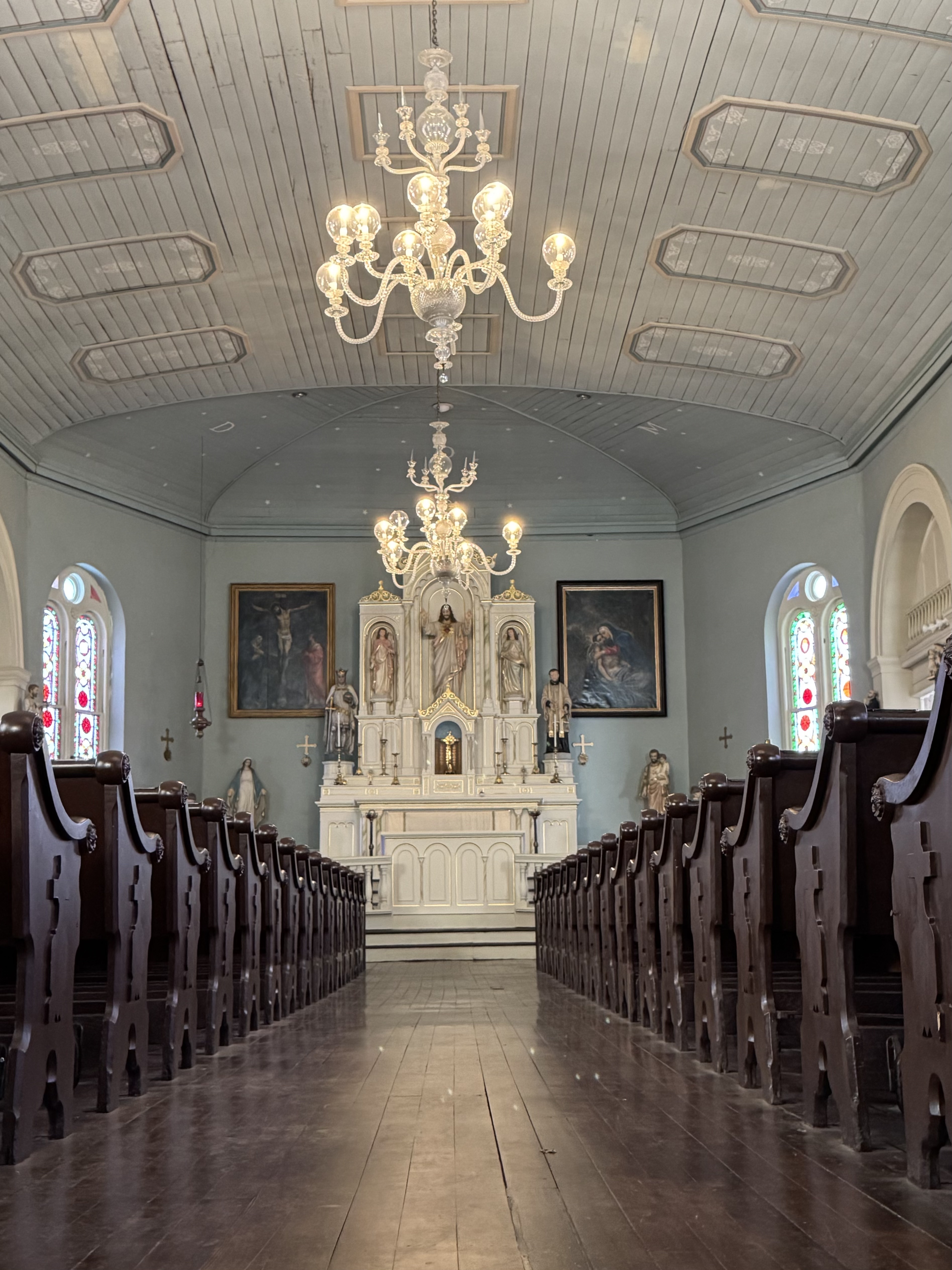
Even the smallest details carry stories. The hard, narrow wooden pews, wavy glass windows, and creaking floorboards, unmistakable with age, set the imagination loose and transport visitors to another era. The ornate crystal French Renaissance-style chandeliers hanging inside the shrine date to the 1904 St. Louis World's Fair. While not original to the building, the chandeliers tell their own story of how sacred places accumulate layers of history over time.
Because the shrine is not regularly open to the public, the pilgrimage offered a rare opportunity not only to visit the site, but to experience it slowly and meaningfully.
Spaces of Daily Life
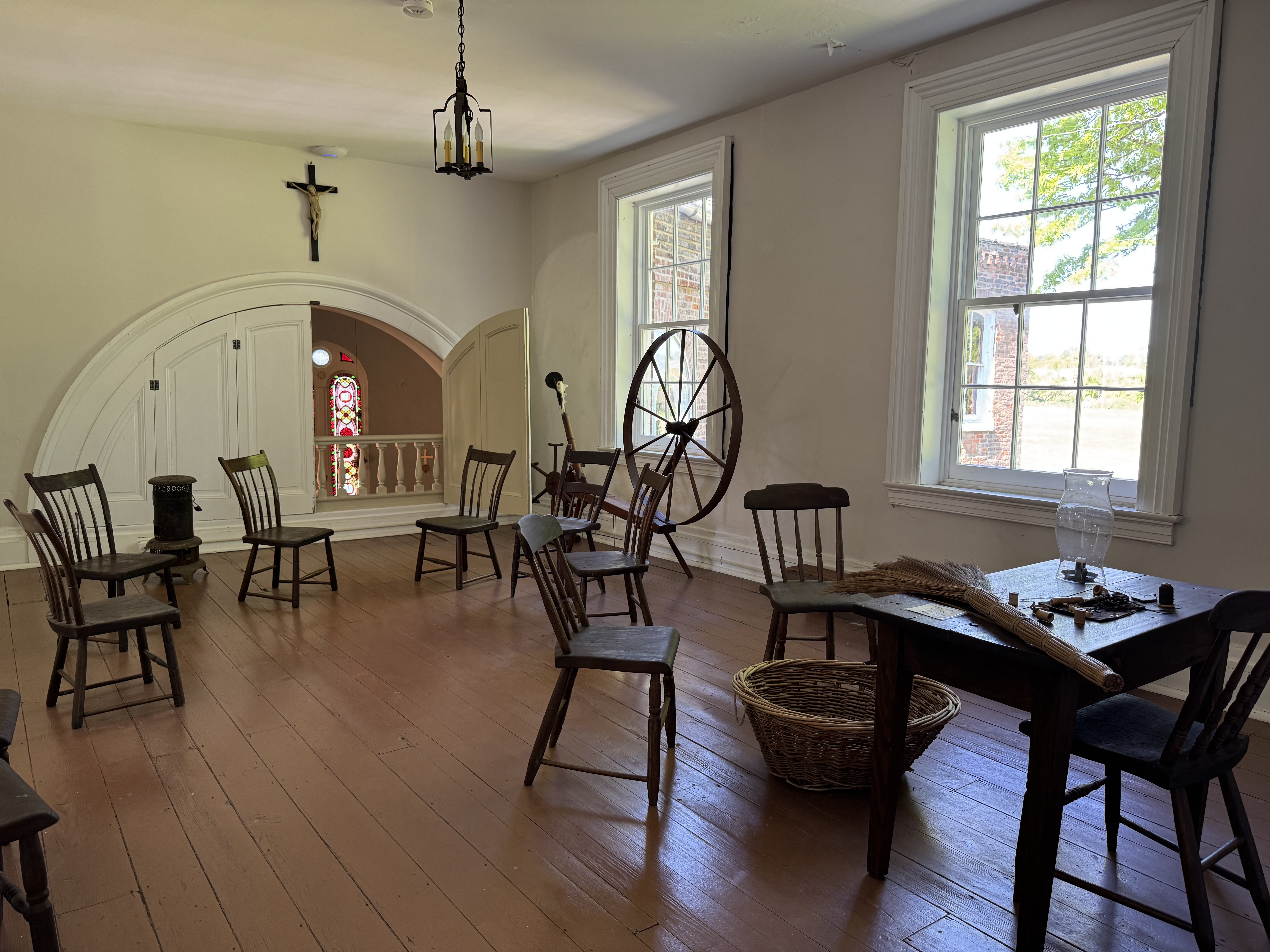
Inside the convent, the structure of daily life became visible to us all through preserved and reconstructed interiors. Rooms that once held the rhythm of prayer, labor, and education now function as points of entry into the past:
On the walls, French-language sketches remain as markers of cultural origin and intellectual life within the convent. The presence of Saint Rose Philippine Duchesne, who served as Mother Superior long before she was canonized as a saint, anchors the space.
During our tour, pilgrims learned that Saint Rose Philippine Duchesne slept on a thin mattress inside a tiny cubby beneath a stairwell so she could remain close to the Blessed Sacrament. It is one thing to read details like this in a history book. It is another thing altogether to stand inside the building itself, seeing her cramped sleeping quarters and listening to old wooden floors creak beneath your feet while imagining the lives once lived there.
Moments like this transform a building into an intimate encounter. It invites the visitor not only to see, but to recognize and enter into memory.
The Role of the Interpreter
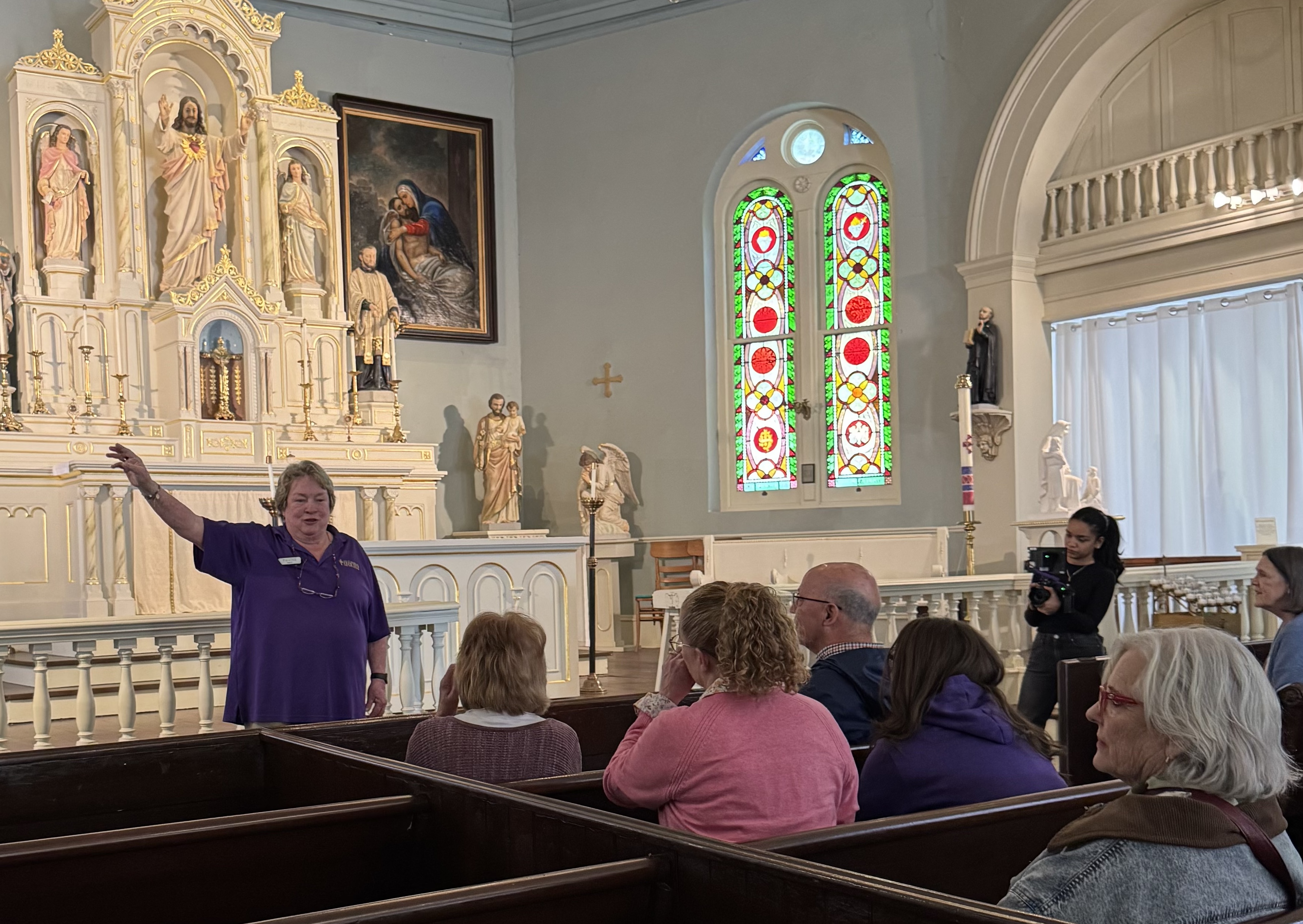
What distinguishes a historic site from a living experience is often the presence of a guide who can translate what remains. Carol Campbell has served as caretaker of the shrine for over a decade and possesses a deep knowledge of the site. Each artifact, each room, each structural detail carries a story, and she is able to draw those narratives forward with humor and poignancy, allowing visitors to step more fully into the story of the place.
A Liturgical Convergence
This pilgrimage coincided with the first Friday of the month, when Mass is still celebrated at the Old St. Ferdinand Shrine. The timing of the pilgrimage allowed us to encounter the shrine not only as a historic structure, but also as a living devotional space still shaped by liturgical life.
Memory and Identity
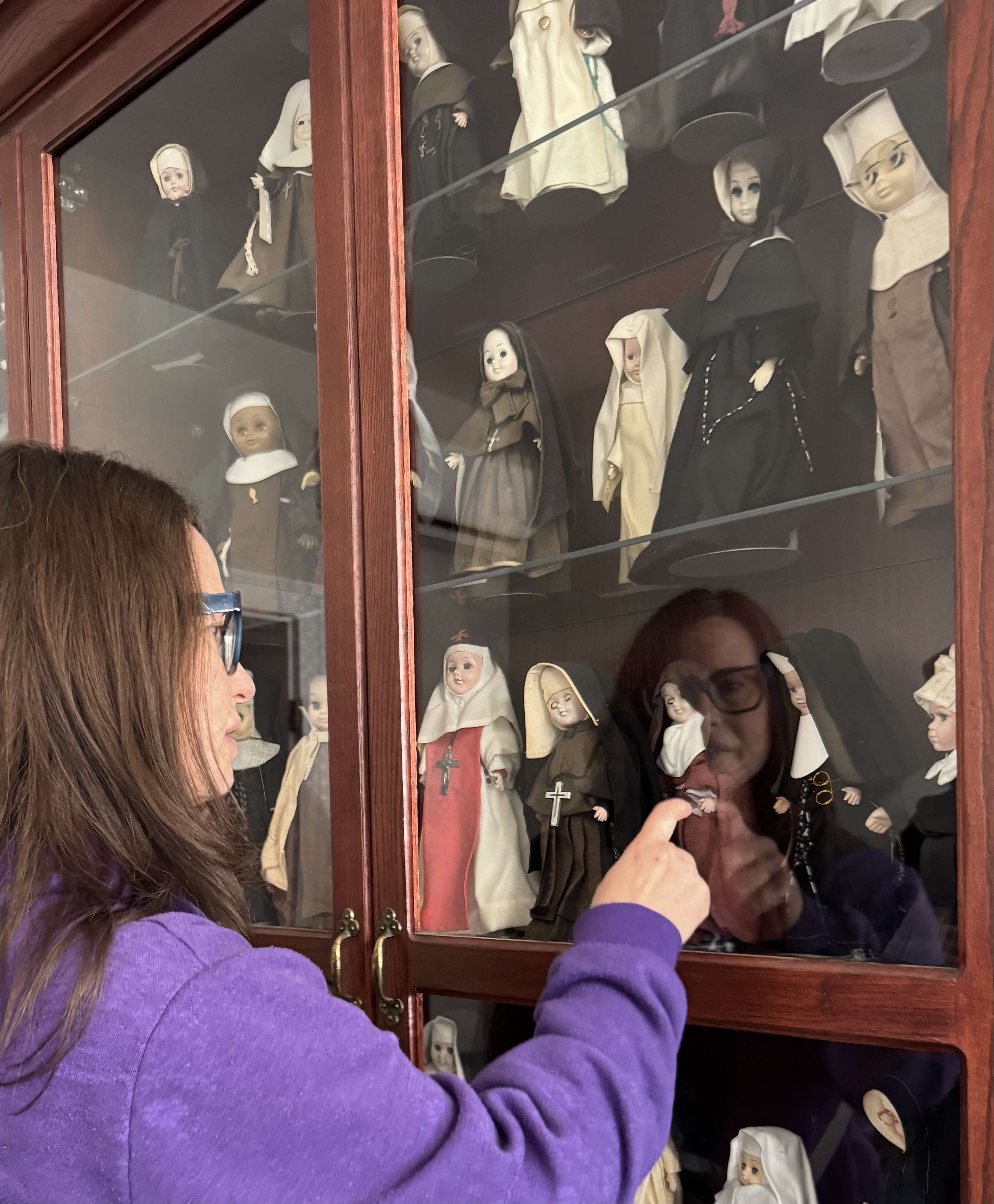
One of the most meaningful moments unfolded far away from the altar itself, when pilgrims gathered around a simple cabinet displaying dolls dressed in the habits of religious orders. Each doll represented a different order of Catholic sisters in St. Louis—more than fifty congregations that helped shape the city in its formative years through education, medicine, human services, and a unique way of life for women who took vows of poverty, obedience, and chastity.
Most people might have walked past the curio cabinet without a second glance, but pilgrimage assignment tends to change the rhythm of attention, and people lean in to look more closely, ask questions, and listen as stories surface. In this case, childhood memories emerged about Catholic school teachers and women religious who had shaped lives decades earlier. Pilgrims who had arrived as strangers began sharing personal memories and discovering unexpected connections while gathered around dolls dressed in religious habits.
It was a reminder that sacred places preserve far more than objects. They preserve relationships, identity, and the invisible threads connecting generations through memory. These connections in quieter moments are one of the reasons I have come to love guiding pilgrimages throughout St. Louis. Each pilgrimage reveals how deeply people long for meaningful connection with sacred places and one another.
One woman joined the May pilgrimage after seeing an announcement appear in her Facebook feed. At first glance, that may seem insignificant. But standing inside a 200-year-old church made it feel important. Someone who had never attended one of our pilgrimages decided to step into a larger story. Human presence is how preservation movements grow. Awareness turns to stewardship.
During my interview with Carol Campbell, she spoke candidly about the importance of visitors. "People cannot protect places they do not know exist. Pilgrimages create visibility and emotional connection. They transform historic sites from forgotten landmarks into living spaces," she said.
Preservation and Continuity
The continued existence of the Old St. Ferdinand Shrine is the result of sustained preservation efforts. Following a natural disaster in 1958, parishioners concerned about the future of the shrine formed the Friends of St. Ferdinand, with the specific purpose of preventing the site's decline. Their work has allowed the property to remain accessible as both a historic and devotional space. Without this intervention, the site would likely have been lost. Friends of St. Ferdinand have come to the aid of the shrine on subsequent occasions, including during a tornado and, more recently, a flood.
Preservation and Continuity
This raises a consistent question within pilgrimage work: What survives, and why?
Preservation is not simply about saving buildings, but sustaining the conditions that allow people to connect. Maybe that is what sacred preservation ultimately means. A structure becomes worthy of preservation when it carries more than architecture—when it also carries memory, sacrifice, beauty, and the accumulated prayers of generations.
At Old St. Ferdinand Shrine, those layers reveal themselves slowly and in small measures. They emerge in the old pine floors beneath pilgrims' feet, underneath the stairwell where Saint Rose Philippine Duchesne lay her head at night, and in glass cases filled with dolls, vestments, and everyday items that were once a part of routine life in the convent, church, schoolhouse, and rectory.
Even the church two miles away, where schoolchildren crowned the Blessed Mother, seemed to carry an ancient rhythm lingering from centuries earlier and generations long ago. Stories that echo in the halls still matter today. They give us context for our own lives and bear witness to living faith, shared humanity, and community memory.
Pilgrimage teaches us to notice these things. Some of the most meaningful sacred places are not the most famous ones. They are often weathered and easily overlooked, waiting for someone willing to step inside long enough to feel the heartbeat of a place.
Pilgrimages like this allow us to enter the story and remain there, even if only for a while. Walk with us. Read the book that inspired the pilgrimage.